Own the Script — a video studio with compliance guardrails built in
Loan officers know they should post video. Most don't — because the page is blank and the rules are scary. Own the Script is a mobile app I founded and designed end-to-end that removes both blockers: a teleprompter that keeps your eyes at the lens, and a compliance engine that reads every script before the internet does.
The problem
In mortgage, the loan officer who shows up in a client's feed every week is the one who gets the call when rates move. But two things break the habit for almost everyone. The first is the blank page — knowing you should post and having nothing to say. The second is fear of the rules: every video a loan officer publishes is legally advertising, governed by TILA/Reg Z, the MAP Rule, UDAAP, and fair-lending law. One wrong phrase — "guaranteed approval," a teaser rate without disclosures — can cost their bank real money. So the rational move is to post nothing. Which is also a cost, just an invisible one.
The insight: consistency is the product. Everything in the app exists to make next week's video easier and safer than this week's.
The system
Own the Script is a pipeline, not a camera. You read once, looking at the lens — the system does the rest: Script → Record → Auto-edit → Compliance → Post.
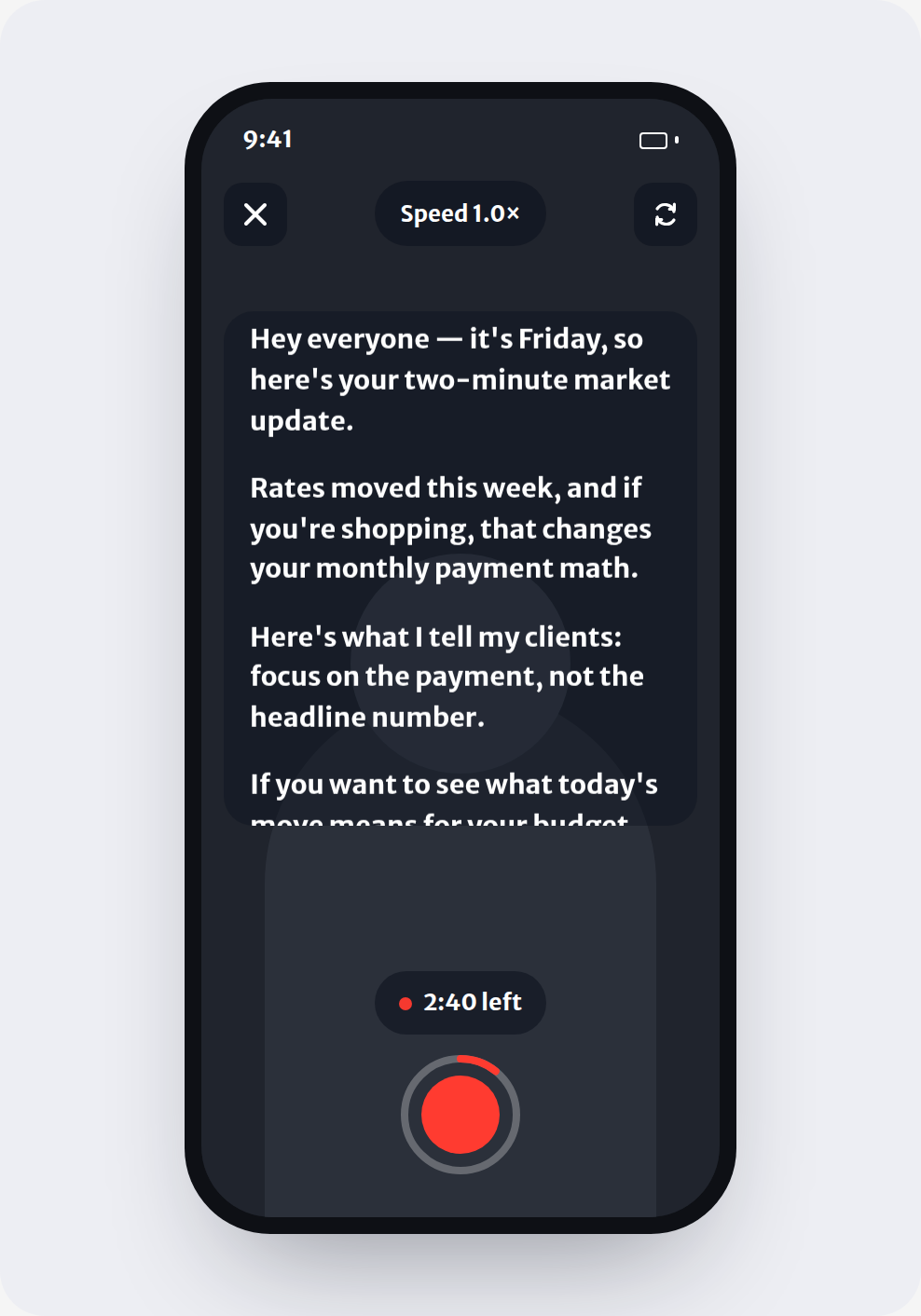
Never open the camera with nothing to say
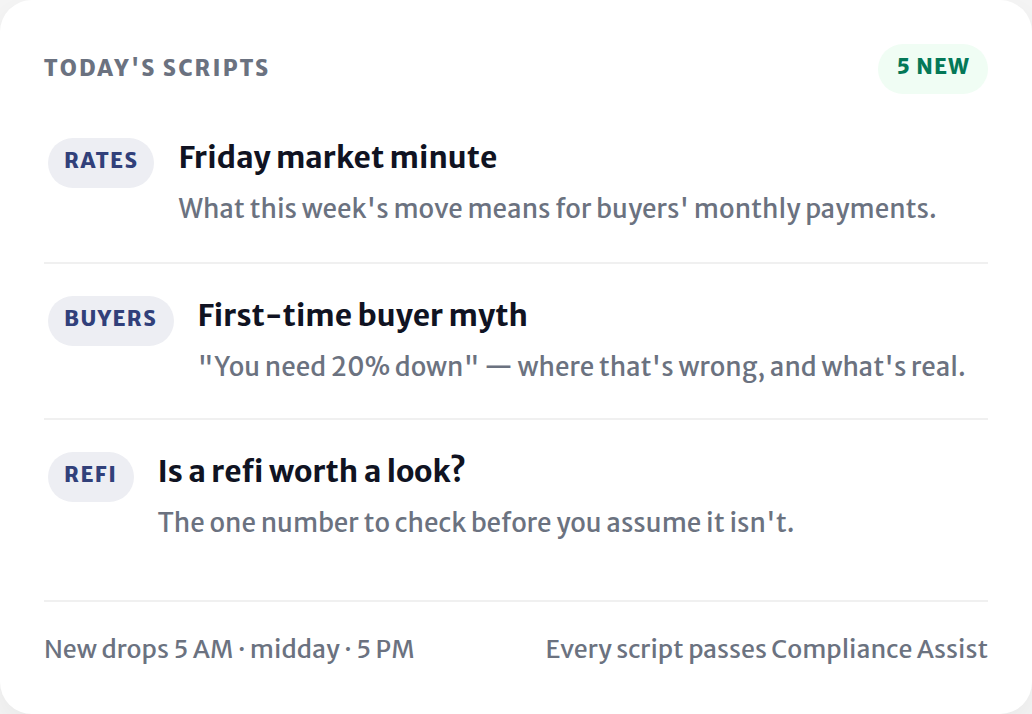
Script Studio delivers fresh, headline-driven scripts three times a day — morning, midday, and evening — written from the day's rate moves and market news, compliant by default. Personalizing one takes a sentence or two.
One take comes back polished
The take is transcribed on-device, then the pipeline does what an editor would: word-by-word animated captions in designer-curated styles, filler words and dead air removed, pacing smoothed, licensed music ducked under the voice, and the user's brand kit applied to every export. Misheard words snap back to the script — the transcript knows you said "homebuyer," not "homeboy."
Compliance as a design material
The hard design problem wasn't the teleprompter — it was making regulation feel like a helpful collaborator instead of a wall of legal text. The approach: treat compliance as structured, actionable feedback. Every transcript runs through a deterministic 19-rule engine covering the MAP Rule (Reg N), Reg Z §1026.24 triggering terms, UDAAP, and ECOA/FHA fair-lending language. Each flag shows four things: the exact phrase, the citation, why it's a problem, and a one-tap compliant rewrite.
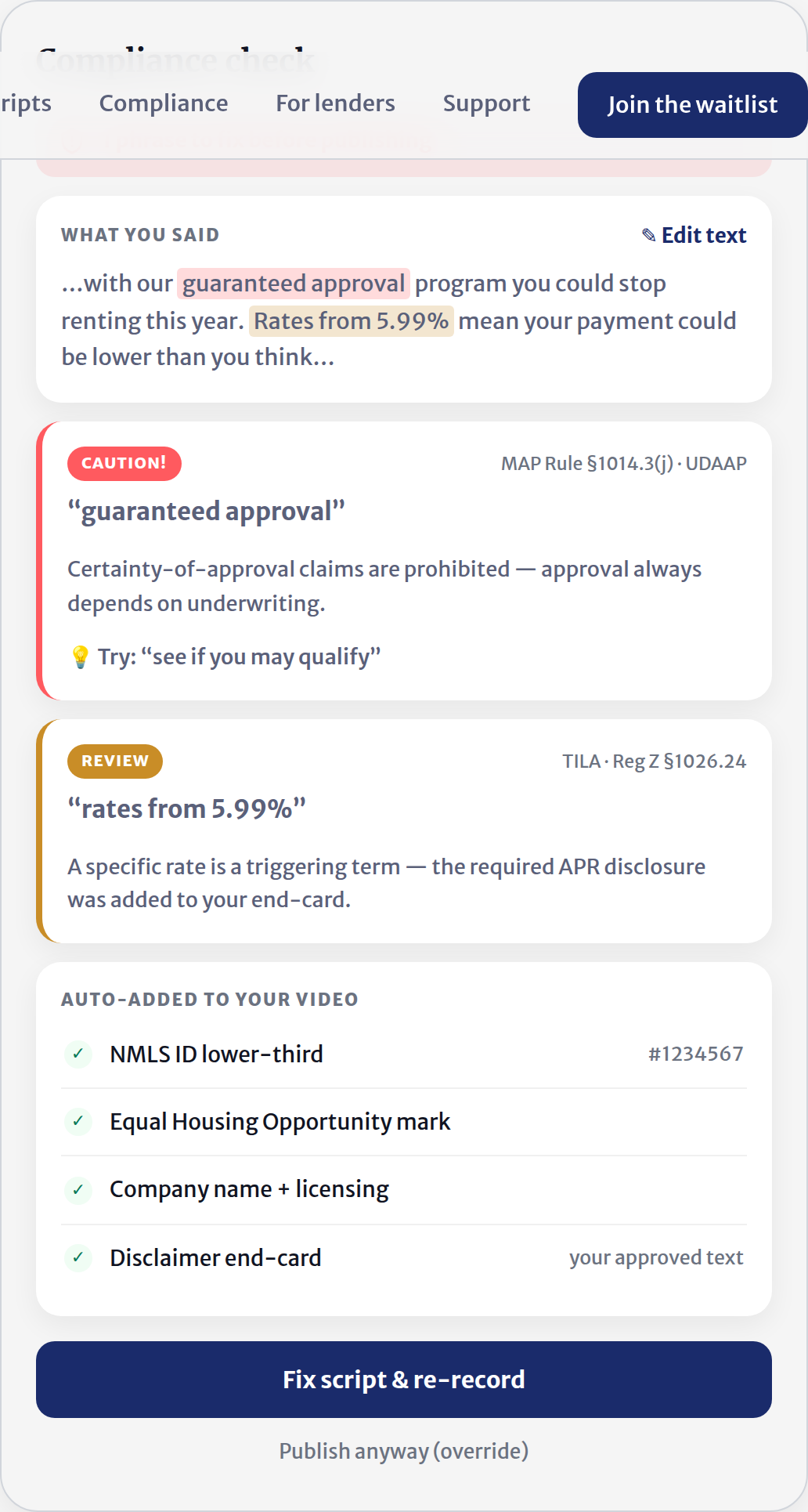
Three structural decisions carry the trust story:
- Soft-block, not hard-block. Serious flags stop publishing by default, but a professional can override with a logged acknowledgment. Autonomy preserved; accountability recorded. Every flag, fix, and override is timestamped for the compliance team.
- Disclosures can't be forgotten. NMLS ID, the Equal Housing mark, company licensing, the disclaimer end-card, and the NMLS Consumer Access link are stamped automatically on every export — the safest disclosure is the one that requires no memory.
- The rulebook lives server-side. When guidance changes, every phone follows the same day — no app release required.
Shipping the whole surface
Being a founder-designer means the product doesn't stop at the app. I designed and shipped the marketing site at ownthescript.app in the app's own design language — down to a working reproduction of the capture screen with a live countdown — plus the legal surface consumers and app stores require: privacy policy, terms, and a data-deletion page. The waitlist runs on the same Supabase backend as the app.
The build process itself reflects how I work now: a human-AI workflow (Claude and Claude Code) across product spec, compliance rule research, design, and the website — with every design decision and regulatory citation reviewed by a human before it shipped.